Custom Optical Lens Guide for LED and Automotive Buyers
A custom optical lens is designed around a specific light source, beam target, housing and operating environment rather than selected from a standard range. In LED lighting, automotive lighting and imaging products, the lens usually decides whether a design meets its photometric target, fits its mechanical envelope and survives its service conditions. This guide covers the lens types involved, the parameters that must be fixed before tooling, the manufacturing capabilities that matter, and the sequence a project follows from drawing to mass production.
What Is a Custom Optical Lens?
A custom optical lens is a secondary optical component produced to a customer's optical, mechanical and environmental specification. It sits between the emitter and the outside world and controls how light leaves the luminaire, headlamp or optical module: beam angle, distribution, uniformity, glare, cutoff and stray light all come from its surfaces.
The category covers several product families that are usually quoted separately: aspheric LED lenses, TIR lenses, Fresnel lenses, freeform optical lenses and other secondary optical lenses for lighting. In lighting applications these are typically moulded from optical-grade polycarbonate (PC) or polymethyl methacrylate (PMMA). Custom parts in this class are commonly specified within a size range of 5–1500 mm and a beam angle range of 2°–120°, from spot to flood, with light transmission above 90% for PMMA and above 88% for PC. Working temperature is generally quoted as -40°C to +120°C for PC and -40°C to +90°C for PMMA.
No fixed model designation applies to the custom category as a whole. The part number, the optical data and the mechanical envelope are defined by the project, which is precisely why the design and tooling conversation matters more than the catalogue.
Problem Definition: Why a Catalogue Lens Often Does Not Fit
Standard lenses are designed around a limited set of assumptions about emitter size, position and housing depth. Real projects rarely respect those assumptions. An LED array with a different pitch, a COB with an unusual light-emitting area, a deeper housing, a sealed front cover or a curved outer lens will all shift the result away from the catalogue performance curve.
The consequences are practical rather than theoretical:
- The delivered beam angle and distribution do not match the photometric target, so the luminaire fails its own specification sheet.
- Light is lost inside the housing because the lens is not matched to the source position, which shows up as reduced efficiency and unwanted stray light.
- The lens does not fit the available depth, draft angle or outer lens curvature, forcing a mechanical redesign around a standard part.
- The material or wall thickness is unsuitable for the operating temperature, UV exposure or vibration profile of the application.
Custom optics resolve these conflicts by defining the source, the optical surface, the mechanical interface and the material together, before any tool is cut.
Industry Background: Why Custom Optics Demand Is Rising
The global optical lens market was valued at USD 21.08 billion in 2025, according to Fortune Business Insights. At application level, TrendForce/LEDinside projects that ADB (adaptive driving beam) headlight penetration will reach 23.8% by 2030 — a shift that pushes automotive lighting from simple illumination towards pixel-level, software-controlled light distribution.
Two broader movements explain the demand for custom rather than catalogue optics. First, lighting specifications have moved from brightness to controlled light: roadway glare limits, dark-sky requirements, retail accent accuracy and uniformity targets on industrial floors all depend on the optical design, not on the LED alone. Second, imaging applications — machine vision, security cameras and UAV optical systems — increasingly require lenses matched to a specific sensor size, working distance and mechanical stack.
Where custom optical lens manufacturing sits in China
China's optics supply base is not a single type of supplier. It includes optical design houses, precision mold makers, injection moulders and integrated manufacturers that combine all three. The practical difference between them shows up at the tooling stage: a moulder that only builds to supplied drawings cannot correct an optical surface that is impossible to release from the mold, and a design house that does not mould cannot validate what it has drawn.
The Solution: Matching Lens Type, Material and Process to the Application
Lens types used in lighting and imaging
Aspheric and TIR lenses form the core of LED secondary optics. TIR (total internal reflection) designs collect light that would otherwise escape sideways and redirect it into the target beam, which makes them the default choice where efficiency and a defined beam angle matter at the same time.
Fresnel lenses use precisely designed annular prismatic facets or microstructures to converge, collimate or redistribute light. Compared with conventional thick lenses of similar focal length they deliver equivalent light control at a much thinner profile, which suits large-area lighting, solar concentration, sensors and other optical devices sensitive to size and weight. Model DB1072 is a documented example of this family.
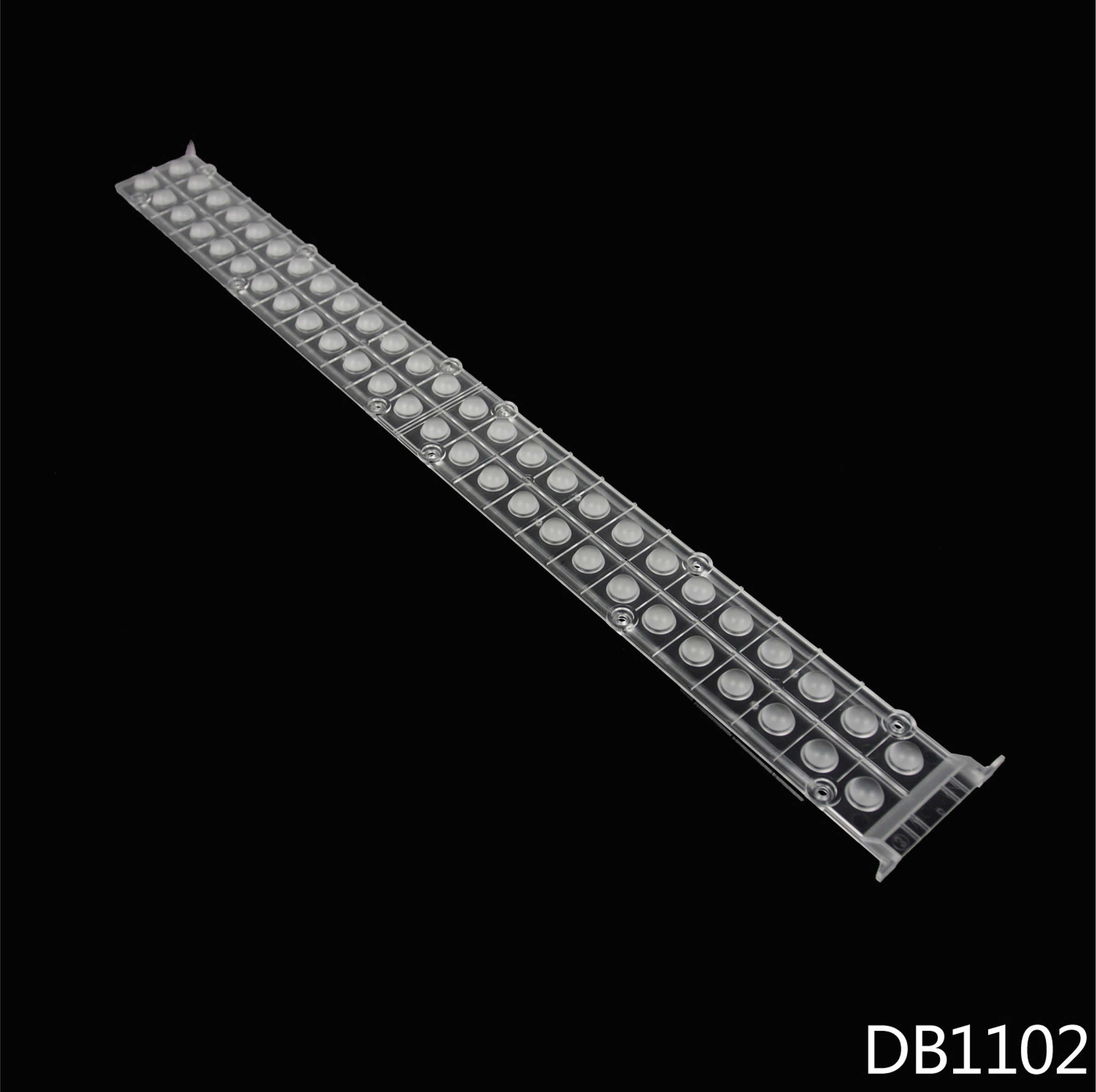
Linear lenses are elongated optics for linear LED luminaires. A well-designed optical structure spreads light evenly across a strip, reduces local hot spots and dark zones, and integrates cleanly with the LED board and housing. Model DB1102 falls in this category and is documented for indoor linear lighting, display lighting, industrial lighting, architectural wall washing and machine vision lighting.
Freeform and thick-wall optics handle cases where the beam must be asymmetric or the lens must carry structural rather than purely optical duties. Thick-wall transparent bodies provide strength and vibration resistance while edge micro-prism structures refract and distribute light; the same approach is used for rear turn-signal optics with a large-curvature free-form profile that follows the lamp lens.
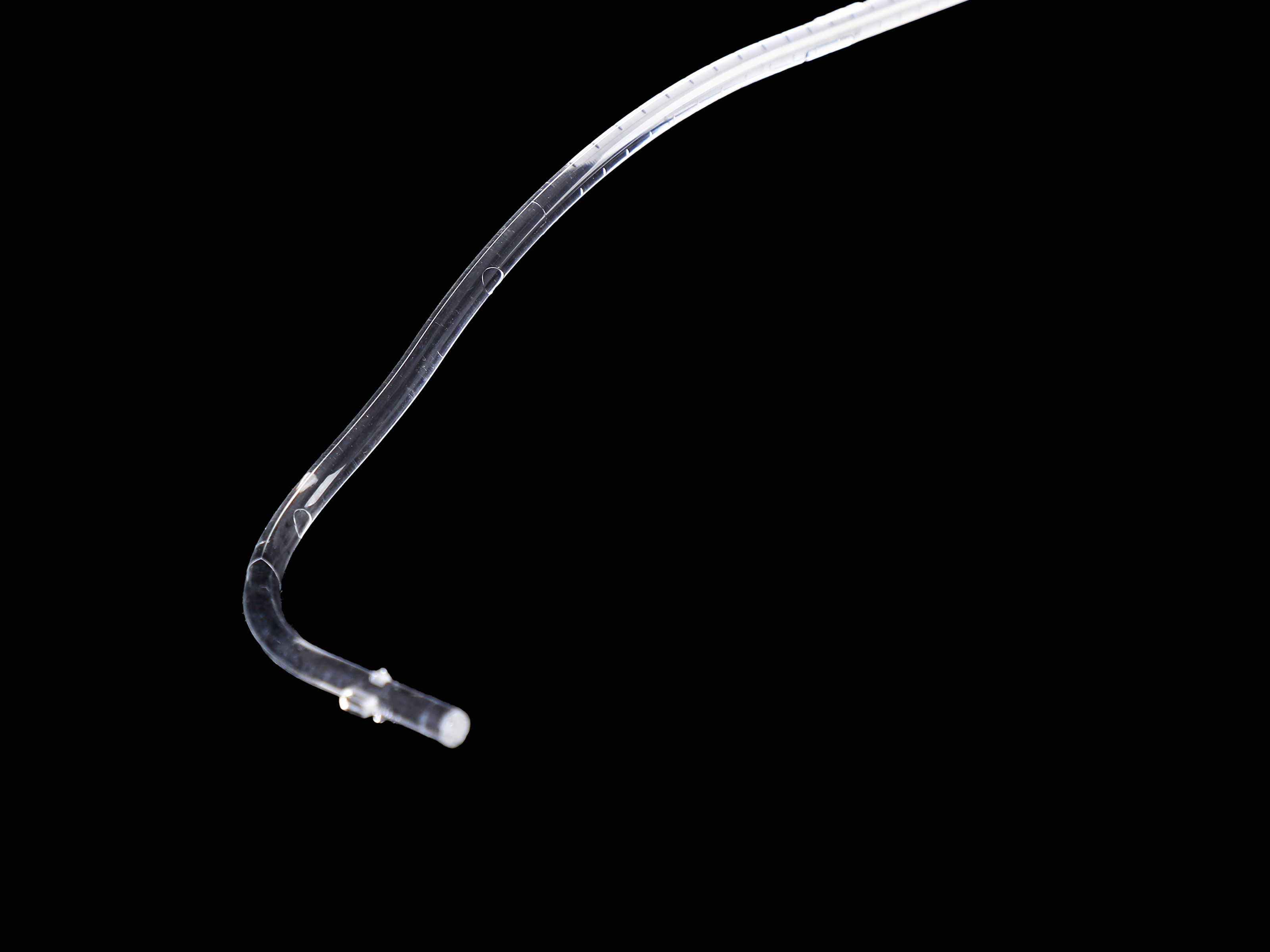
Light guides serve ambient and decorative functions. High-transmittance optical material plus a precision light-guiding structure produces even, soft illumination without visible bright spots, and the geometry can run to substantial lengths.
Materials and optical parameters to lock before tooling
PC and PMMA remain the two workhorses of LED optics, and the choice drives the rest of the specification. PC brings a higher working ceiling and better impact resistance; PMMA brings higher transmission. In practice the parameters that must be agreed before mold design are:
- Light source data: emitter type, light-emitting area, position and tolerance, drive current.
- Optical targets: beam angle, distribution type, cutoff or asymmetry, uniformity, glare limits.
- Dimensional requirements: overall size, wall thickness, draft, parting line position, assembly clearance.
- Surface requirements: optical surface definition, surface roughness, gate and ejector positions.
- Environmental requirements: operating temperature, UV exposure, humidity, vibration.
- Inspection requirements: which dimensions and which optical characteristics will be measured, and how.
Manufacturing capability that changes the outcome
Zhejiang Bicom Optics Co., Ltd is an optical lens and precision injection mold manufacturer based in Jiashan County, Zhejiang Province, China, established in 2005. Its operations cover research and development, design, production and sales, with a portfolio spanning optical lenses, precision injection molds, automotive lighting lenses and automotive ambient lighting. The company holds TS16949 automotive technical specification certification and ISO 9001 quality management system certification; its recorded certification status also lists ISO 9001, ISO 14001 and ISO 45001.
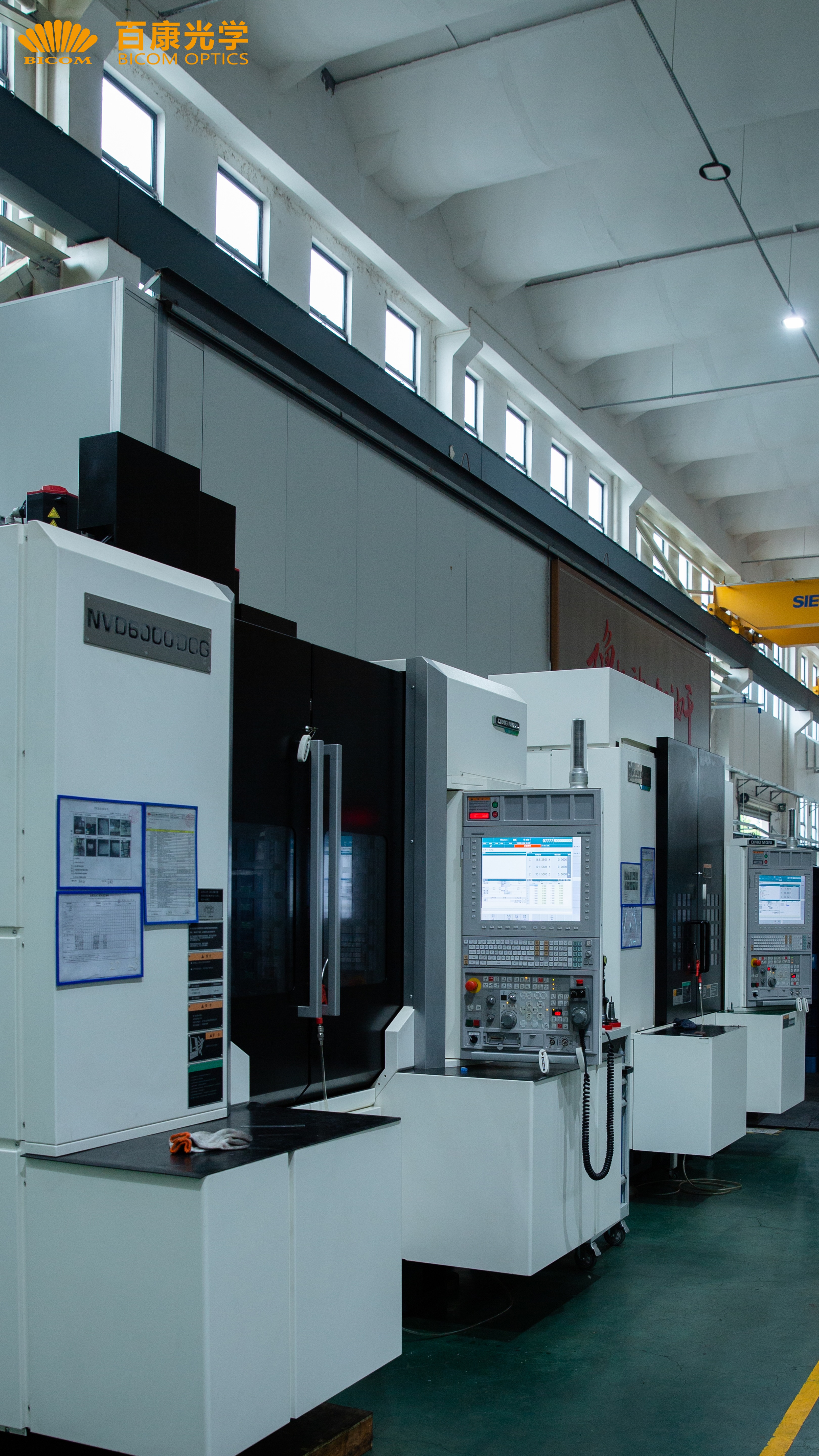
The capability figures that matter at the quotation stage are concrete. The manufacturing facility covers 90,000 m² and employs approximately 700 staff, with annual production capacity of 90,000,000 pieces per year and a 50-person R&D team. Tooling and moulding are built around nanoscale CNC machinery with positioning accuracy up to 10 nanometers and mold cavity precision adjustable to within 5 microns. The company has developed high-precision thick-wall lenses up to 50 mm thick and automotive light guides up to 1,300 mm in length, and can manufacture two-color and three-color products in a single production run. Its innovation record includes 167 patents, of which 17 are invention patents and 150 are utility model patents. Export business accounts for 30% of total sales, serving the EU, USA, Middle East, Japan and Korea.
Step-by-Step Breakdown: From Drawing to Mass Production
Custom optical components follow a defined development route. The standard workflow runs: requirement confirmation → engineering assessment → DFM → quotation → mold development → T0 sampling → test and validation → optimization → customer approval → mass production. A prototype mold or a production mold can be used depending on the project phase.
- Requirement confirmation. Both parties confirm the 2D drawings, 3D files, optical data, material requirements, application and service environment. This is the point where missing information is cheapest to fix.
- Engineering assessment and DFM. Product structure and manufacturing feasibility are reviewed, covering optical surfaces, wall thickness, gates, ejector pins, parting lines, cavity quantity, shrinkage and deformation. The mutually confirmed drawings, optical data and DFM report become the baseline for mold building, sampling and mass production, with revision control applied to design changes.
- Quotation. Cost, development lead time and manufacturability are evaluated against the confirmed specification.
- Mold development. Cavity count, steel selection, optical surface machining and cooling layout are settled against the agreed tolerance band.
- T0 sampling. First parts are produced and submitted for dimensional, optical and appearance checks.
- Test and validation. Samples are validated for dimensions, optical performance, appearance and assembly against the product specification.
- Optimization. Mold or process adjustments follow from the test results rather than from assumption.
- Customer approval. Mass production is released only after customer confirmation.
- Mass production and consistency control. Stability is maintained across raw materials, molds, injection-molding process, dimensional inspection, optical performance and appearance, supported by production traceability and continuous process monitoring.
For high-volume projects, two further questions belong on the table before the first mold is cut: whether the supplier's equipment and multi-cavity capability match the expected order volume, and whether capacity expansion and supply continuity can be supported as volumes grow.
Use Cases Across Lighting and Imaging
Custom optical lenses are passive secondary components working with LED sources, and they are specified in systems that run continuously indoors and outdoors, across a wide temperature range, in high humidity and under UV exposure.
Automotive lighting
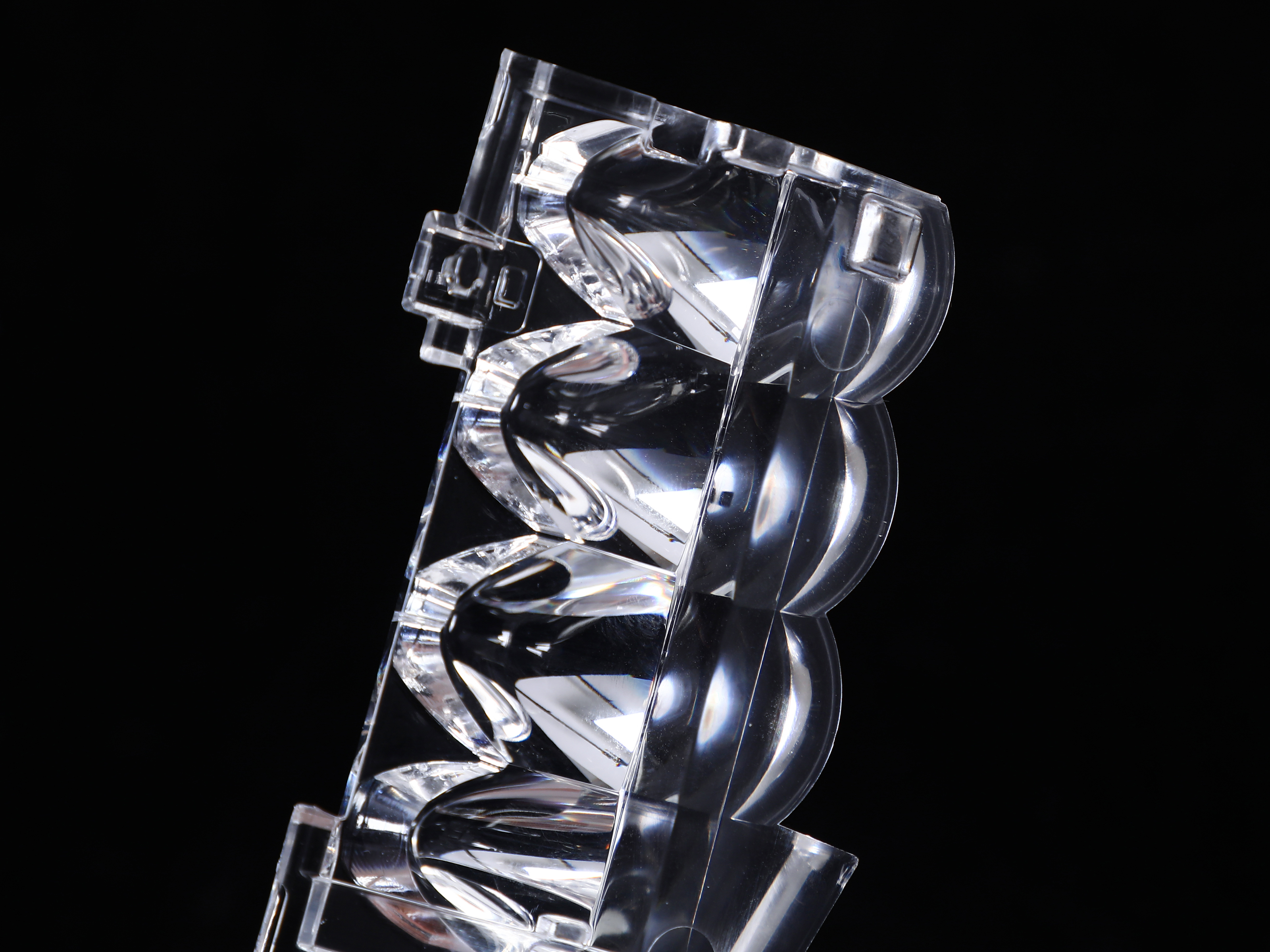
Automotive optics is the most demanding application in the category because the beam pattern is regulated and the environment includes vibration and long duty cycles. Documented product families include the low beam inner lens, which uses a multi-cavity optical array with independent light distribution for each LED and a free-form inner surface to reduce optical loss; the HB collimator for high beam, which combines a free-form surface with a reflective/refractive structure to concentrate LED light for long-distance projection and suppress stray light and glare; the thick-wall headlamp lens; the combined low and high beam headlamp lens, which integrates both functions into a single lens to cut part count and module size; and the thick-wall optic for rear turn signal lamps. Ambient lighting uses light guide components made from high-transmittance optical-grade material, with resistance to yellowing, embrittlement and light decay over long operation.
Street, industrial and architectural lighting
Street and outdoor luminaires depend on asymmetric distributions that keep light on the road and out of windows; industrial high-bay and low-bay fixtures depend on uniformity at working height; architectural wall washing and commercial downlights depend on control of the beam edge. Linear lenses cover continuous strip lighting, display lighting and machine vision lighting where the source is elongated rather than a single point.
Security, stage and projection
Security and surveillance flood lighting, stage moving-head and wash lights, and LED projector optics all use secondary lenses to convert a bare emitter into a defined output. In these systems the lens is a replaceable element of the optical train, so dimensional consistency between batches becomes a procurement requirement rather than a preference.
Imaging applications
Machine vision lenses, security camera lenses and UAV optical lenses are matched to sensor format, working distance and mechanical stack. Bicycle lighting is a further custom category where the optical design governs both light propagation direction and distribution, and where spotlight, flood and custom-shaped beam configurations can be tailored to the luminaire design.
Comparison Table: Lens Type vs Documented Application
| Lens type | Documented applications | Documented structural or optical feature |
|---|---|---|
| Linear lens (DB1102) | Linear LED luminaires; indoor linear lighting, display lighting, industrial lighting, architectural wall washing, machine vision lighting | Elongated profile for continuous illumination; reduced hot spots and dark zones |
| Fresnel lens (DB1072) | Large-area lighting, solar concentration, sensors, optical devices sensitive to size and weight | Annular prismatic facets or microstructures; thin, lightweight construction |
| Aspheric / TIR / freeform secondary optics | Automotive, street and outdoor, industrial, security and surveillance, stage and entertainment, projector and display, architectural and commercial lighting | Beam angle 2°–120°; transmission above 90% (PMMA) and above 88% (PC); PC or PMMA material |
| Thick-wall headlamp lens | Automotive headlamp applications | Thick-wall body with free-form surfaces; concentrated spot and defined cutoff |
| Combined low and high beam headlamp lens | Automotive headlamp assemblies | High and low beam optical surfaces integrated in one lens; reduced part count |
| Low beam inner lens / LB collimator | Low beam headlamp modules | Multi-cavity optical array; free-form inner surface; sharp cutoff and low glare |
| HB collimator | Automotive high beam lighting | Free-form surface combined with reflective/refractive structure; long-range projection, low stray light |
| Automotive light guide | Automotive ambient lighting | Precision light-guiding structure; high transmittance, UV and vibration resistance; available up to 1,300 mm |
| Bicycle light lens | Bicycle lighting | Governed light propagation direction and distribution; spotlight, flood and custom-shaped beams |
Two verification points sit behind this table. First, the numbers apply to the documented product family, not to every future part — final optical performance is confirmed at T0 and validation, not at quotation. Second, the certification scope and validity of any supplier's quality and automotive certificates should be confirmed with the certificate issuer rather than assumed from a website claim.
Frequently Asked Questions
Which certifications should a custom optical lens manufacturer hold?
For lighting optics, a quality management system certificate such as ISO 9001 is the baseline. For automotive lighting lenses, automotive technical specification certification matters because it implies the supplier's processes have been assessed against automotive industry requirements. Zhejiang Bicom Optics Co., Ltd holds TS16949 automotive technical specification certification and ISO 9001 certification, and its recorded certification status also lists ISO 9001, ISO 14001 and ISO 45001. Buyers should confirm the scope, the certified site and the validity date directly with the supplier before qualification.
How can I verify a supplier's custom optical lens development capability?
Producing to drawings is not the same as developing a lens. Verify the full-cycle chain from requirement definition to mass production: optical design, structural evaluation, DFM, mold flow analysis, mold design and fabrication, precision injection molding, optical testing and mass-production support. Then check past custom project references, experience with similar products, the engineering team and the actual production equipment. A supplier that can participate in product development rather than only machine to prints will raise optical-surface and draft-angle problems during DFM, not after T0.
How is a custom optical lens project priced?
Custom optical lenses are quotation-based; there is no catalogue price that applies across geometries. Cost is driven by the specification itself: lens size and wall thickness, optical surface complexity, cavity count and mold construction, material grade, tolerance band, inspection and optical-testing requirements, and the volume expected over the mold's life. The practical way to compare suppliers is to issue the same drawing pack — 2D drawings, 3D data, optical data, material requirements, application and service environment — to each shortlisted manufacturer and compare the returned DFM findings alongside the price.
What is the sampling and confirmation process for a custom lens?
The standard route is requirement confirmation, engineering assessment, DFM, quotation, mold development, T0 sampling, test and validation, optimization, customer approval and then mass production. A prototype mold or a production mold can be used depending on project phase. Once samples are complete, they are validated for dimensions, optical performance, appearance and assembly against the product specification, and necessary mold or process adjustments are made on the basis of those results. Mass production starts only after customer confirmation.
What affects lead time on a custom optical lens project?
Lead time is governed by the number of steps between drawing and approval rather than by molding speed alone. The main variables are the completeness of the input data, the complexity of the optical surfaces, the number of cavities, how many sampling and optimization rounds the optical performance requires, and the capacity available at the mold shop and the molding line. Projects that arrive with confirmed optical data, tolerances and assembly requirements move through DFM and T0 with fewer revision loops. To get a realistic schedule for your part, send the drawing pack to charlean@bicomoptics.com and ask for an engineering assessment before quotation.
Conclusion
Choosing a custom optical lens is really a decision about who defines the optical surface, the mold and the molding process. Catalogue optics work when the source, housing and photometric target happen to align; custom optics exist for the far more common case where they do not. The buyers who get predictable results are the ones who fix the light source data, the optical target, the mechanical envelope and the inspection method before tooling starts, then confirm the supplier's capability at DFM, T0 and validation rather than accepting a data sheet at face value.
Next Step: Sample and Quotation Request
Zhejiang Bicom Optics Co., Ltd develops and manufactures custom optical lenses, precision injection molds and custom optical components for automotive, street and outdoor, industrial, security, stage, projector and architectural lighting, plus machine vision, security camera and UAV imaging applications.
To move a project forward, send your 2D drawings, 3D data, optical data, material requirements and service environment for an engineering assessment. Contact Charlean He — charlean@bicomoptics.com, +86 135-5877-5757, No.258, West Yunsi Rd, Dayun Town, Jiashan County, Jiaxing City, Zhejiang Province, China. Company website: www.bicomoptics.com.
Have Questions or Need More Details?
Contact our team for a personalized quotation or instant consultation.
Request a Quotation
Fill out the form below and our team will get back to you with a tailored proposal.
WhatsApp Direct Chat
Prefer to chat in real-time? Message us on WhatsApp for instant assistance & quick answers.
- Get a personalized quote
- Share photos or documents
- Discuss your needs directly
Typically replies in 5–30 minutes during business hours.