
Custom Optical Lens: A Buyer's Guide to LED Secondary Optics
A custom optical lens is an optical component designed, tooled and injection-molded for one specific light source, luminaire or lamp assembly instead of being selected from a standard catalogue. It is usually the last optical element between an LED and the space that LED has to light, and it decides whether the output arrives as a controlled beam, an even line of light, or a soft ambient glow.
This guide is written for buyers and engineers in the awareness and research stage: the point where a luminaire concept exists, a photometric target has been set, and the open questions are what a custom optic actually is, what it can reasonably be expected to do, and how the supply side is organised.
Quick answer: A custom optical lens is a secondary optic produced to customer specification in optical-grade PC or PMMA, typically 5–1500 mm in size, with a beam angle of 2°–120°, transmission above 90% for PMMA and above 88% for PC, and an operating range of -40°C to +120°C (PC) or -40°C to +90°C (PMMA).
What Is a Custom Optical Lens?
In LED lighting, primary optics sit inside the LED package; secondary optics sit after it. A custom optical lens is that secondary optic, made to the customer's own optical, mechanical and material specification. Typical product types are aspheric LED lenses, TIR lenses, Fresnel lenses, freeform optical lenses and secondary optical lenses for lighting; in material terms the parts are classified as LED optical lenses and plastic optical lenses. Because the geometry is project-specific, no fixed model designation applies — the part is produced to custom specifications.
The definition matters because a custom optic is defined by its interfaces as much as by its curve. The optical surface has to match the LED footprint and its emission pattern, the mechanical outline has to fit the housing, PCB and sealing arrangement, and the material has to survive the same thermal and UV load as the luminaire. A catalogue lens satisfies none of these specifically, which is why fitting one often forces a compromise in the housing or in the photometric result.
The Problem: Raw LED Output Is Not Yet a Lighting Design
An LED emits into a hemisphere with a distribution that is convenient for the package and inconvenient for the application. Left unshaped, that output produces hotspots, glare above the horizontal, uneven strips in linear fixtures and wasted light outside the target area. The job of the secondary optic is to convert raw emission into a defined result: a low-beam cutoff line, a wide asymmetric distribution for a street light, uniform illumination along a linear fixture, or a soft even glow inside an ambient light guide.
The lens has to do this in a demanding environment. Bicom Optics specifies indoor and outdoor operation across a wide temperature range (-40°C to +105/120°C), high humidity, UV exposure, vibration in automotive use, and continuous 24/7 operation. The optic is a passive component, but it is not a low-stress one.
That combination creates the real design tension. More optical control usually wants more optical path length, greater wall thickness or more complex surfaces — which costs material, cycle time and tooling precision. Higher transmission and a higher thermal ceiling do not always arrive in the same grade. Where programme volume is high, molding one part that performs several functions — light distribution plus mechanical location, or two colours in a single shot — is often worth more than a theoretically cleaner single-function optic.
When a custom optic is the right decision:
- The selected LED is not covered by any standard optic's design set.
- The housing, PCB or sealing geometry is already fixed by the industrial design.
- The photometric target — cutoff, asymmetric distribution, uniformity along a length, or a soft ambient glow — cannot be met with a catalogue part.
- The part must combine optical and mechanical functions, or combine two or three colours in one molding run.
- Programme volume justifies tooling.
Industry Background: Why Secondary Optics Carry More of the Design
Fortune Business Insights valued the global optical lens market at USD 21.08 billion in 2025. Market definitions differ by scope — ophthalmic versus industrial versus lighting optics — so the figure is best read as a directional indicator of scale rather than as a lighting-optics-only number.
Within lighting, the clearest structural driver is automotive. TrendForce / LEDinside projects that vehicles equipped with ADB (adaptive driving beam) headlights will reach a 23.8% penetration rate by 2030. ADB works by controlling light in individually addressable zones, and each zone needs its own optical channel. That pushes headlamp design away from a single reflector-plus-lens arrangement and toward freeform inner lenses and multi-cavity optical arrays, where several optical cavities in one molded part each shape the light of a separate LED.
The same logic appears further down the power scale. Secondary optics are now specified across automotive lighting, street and outdoor lighting, industrial lighting, security and surveillance lighting, stage and entertainment lighting, projector and display lighting, and architectural and commercial lighting — each with its own beam requirement, its own housing constraint and its own thermal budget.
The supply base for these parts is concentrated in optical molding regions. Zhejiang Bicom Optics Co., Ltd is a custom optical lens and precision injection mold manufacturer based in Jiashan County, Jiaxing City, Zhejiang Province, China, established in 2005 and serving markets in the EU, USA, Middle East, Japan and Korea, with export business accounting for 30% of total sales.
The Five Parameters That Define a Custom Optical Lens
Almost every custom optic quotation and drawing pack resolves into the same five parameters. Making them explicit early shortens the engineering phase more than any other single action.
1. Material: PC or PMMA
Custom optical lenses in this category are molded in optical-grade polycarbonate (PC) or polymethyl methacrylate (PMMA). PMMA offers transmission above 90% and an operating range of -40°C to +90°C. PC offers transmission above 88% with an operating range of -40°C to +120°C. When the optic sits close to a high-power LED and must hold its shape at elevated temperature, the higher PC ceiling matters; where the design is transmission-limited and the thermal load is lower, PMMA's higher transmission matters.
2. Optical architecture
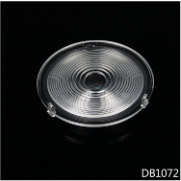
The architecture fixes what the lens can do. Aspheric surfaces shape a rotationally symmetric beam from spot to flood. TIR (total internal reflection) structures collect emission at wide angles and redirect it. Fresnel facets reproduce the focal power of a thick lens in a thin profile — the DB1072 Fresnel lens is intended for large-area lighting, solar concentration, sensors and optical devices sensitive to size and weight. Freeform surfaces produce asymmetric distributions and cutoff lines. Linear optics spread light along a strip. Thick-wall optics combine structural strength with dense micro-prism extraction. Light guides transport light along a length and release it evenly.
3. Size envelope
Custom lenses in this product category range from 5 mm to 1500 mm and are sized to the luminaire rather than to a catalogue. Two capability limits are worth asking about directly, because they decide whether a design is moldable in one piece: thick-wall lenses up to 50 mm thick, and automotive light guides up to 1,300 mm in length.
4. Beam angle and light distribution
Beam angle is specified from 2° to 120°, from narrow spot to wide flood, and light distribution profiles are customisable — spot, flood, batwing and asymmetric distributions, plus custom-shaped beams tailored to a specific luminaire design and custom light distribution profiles tailored to the lighting requirement.
5. Mechanical and molding features
This is the parameter buyers most often under-specify. Wall thickness, gate location, ejector pin positions, parting lines, cavity quantity, shrinkage and deformation all have to be reviewed before tooling, alongside dimensional tolerances, optical surface definition, assembly requirements and surface roughness. A drawing that describes the optical surface but not the molding envelope produces a DFM round trip rather than a useful quotation.
| Parameter | Specification | Practical meaning |
|---|---|---|
| Material | Optical-grade PC or PMMA | Thermal ceiling versus transmission |
| Size | 5–1500 mm, customizable | Matched to the luminaire, not to a catalogue |
| Beam angle | 2°–120°, customizable | Spot through wide flood, plus custom profiles |
| Transmission | >90% (PMMA), >88% (PC) | Light delivered versus light lost in the optic |
| Operating temperature | -40°C to +120°C (PC); -40°C to +90°C (PMMA) | Selection driver for high-power LED designs |
Step-by-Step Breakdown: From Drawing to Mass Production
Custom optical components follow a development sequence rather than a simple purchase order. The sequence is stable; the duration varies with optical complexity and the number of validation rounds.
- Requirement confirmation. The customer provides 2D drawings, 3D data, optical data, material requirements, the product application and the service environment. The detail set covers dimensions, tolerances, optical surfaces, assembly requirements, surface roughness, light-source information, material grade, working temperature and performance requirements. This is what allows a supplier to evaluate manufacturability, cost and development lead time.
- Engineering assessment and DFM. The supplier reviews the structure and manufacturing feasibility — optical surfaces, wall thickness, gates, ejector pins, parting lines, cavity quantity, shrinkage and deformation. The mutually confirmed drawings, optical data and DFM report become the baseline for tooling, sampling and production.
- Quotation. Issued against the confirmed specification and manufacturing route, not against a photograph or a competitor's part number.
- Mold development. Precision injection mold design and fabrication. Bicom Optics adjusts mold cavity precision to within 5 microns and uses nanoscale CNC machinery with positioning accuracy up to 10 nanometers.
- T0 sampling. First-off samples from the new tool. Either a prototype mold or a production mold can be used, depending on the project phase and requirement.
- Test and validation. Samples are validated for dimensions, optical performance, appearance and assembly against the product specification.
- Optimization and customer approval. Mold or process adjustments are made on the basis of test results, and the part is then submitted for approval. Revision control keeps a single specification revision in force across tooling, sampling and production.
- Mass production and consistency control. Consistency is controlled across raw material, mold, injection-molding process, dimensional inspection, optical performance and appearance, supported by production traceability and continuous process monitoring.
When a quality issue does appear, the resolution path is equally structured: clarify the phenomenon, batch, quantity, affected cavities and impact scope; segregate product, add inspection or hold shipment; analyse root cause across material, mold, equipment, process, measurement and operation; implement corrective action; verify effectiveness by sampling. Batch-level or complex issues are handled with 8D closed-loop analysis.

What Capability Looks Like in Practice
Capability claims are only useful when they map to a design constraint. The following figures come from the manufacturer's own operational data and are stated here so that buyers can test them against a specific drawing.
- Scale: a 90,000 m² manufacturing facility, approximately 700 employees and annual production capacity of 90,000,000 pieces per year.
- Engineering depth: a 50-person R&D team, a research and development centre recognised as a Research and Development Center of High-tech Enterprises, and more than 167 patents — 17 invention patents and 150 utility model patents.
- Tooling precision: nanoscale CNC machinery with positioning accuracy up to 10 nanometers; mold cavity precision adjustable to within 5 microns.
- Part envelope: high-precision thick-wall lenses up to 50 mm thick and high-precision automotive light guides up to 1,300 mm in length.
- Multi-material molding: two-colour and three-colour products manufactured in a single production run, which removes a secondary assembly step from the luminaire build.
- Product breadth: LED optical lenses, automotive lighting lenses, industrial lighting optics, machine vision lenses, security camera lenses, UAV optical lenses, optical lens molds and custom optical components, plus automotive ambient lights.
For a buyer, the practical question is which of these removes a constraint from your own design. A 50 mm wall thickness sets the upper bound on how much optical path can be molded in one piece. A 1,300 mm light guide sets the length at which a continuous ambient line can be a single molded part instead of a spliced assembly. Two-colour molding in one run changes the assembly sequence, not only the unit cost.
Use Cases: Where Custom Optics Change the Result
Automotive exterior lighting
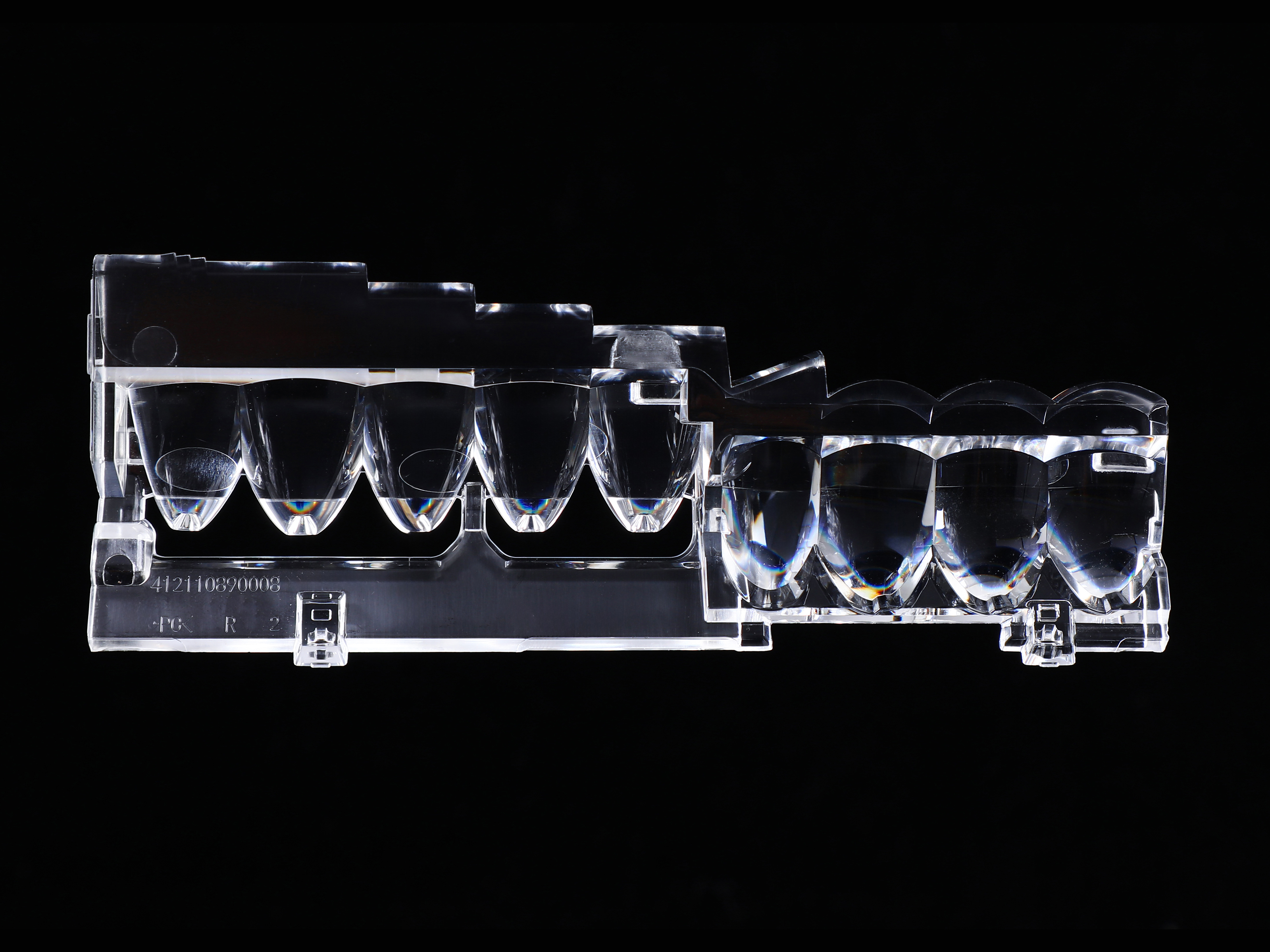
Low-beam and high-beam collimators, combined low- and high-beam headlamp lenses, thick-wall headlamp lenses and thick-wall rear turn-signal optics. The low-beam inner lens uses a multi-cavity optical array in which each cavity distributes light for an individual LED, with a free-form inner surface that collimates light and reduces optical loss. The combined headlamp lens integrates high- and low-beam optical surfaces into a single part, cutting part count and module size. The thick-wall rear turn-signal optic uses a dense micro-prism edge structure to refract light evenly with no dark zones, and a large-curvature free-form profile that fits the rear lamp lens with minimal assembly clearance.
Automotive ambient lighting
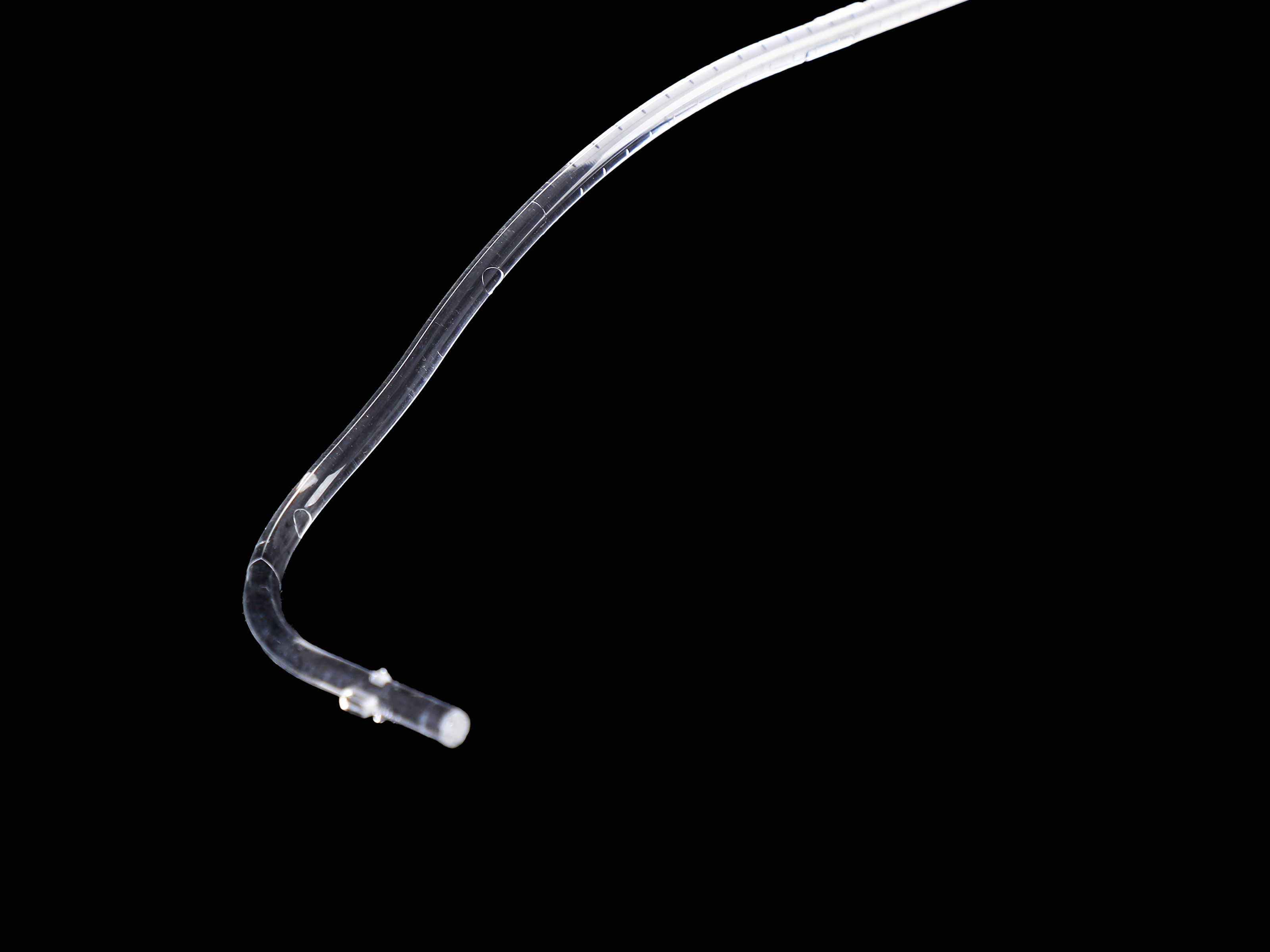
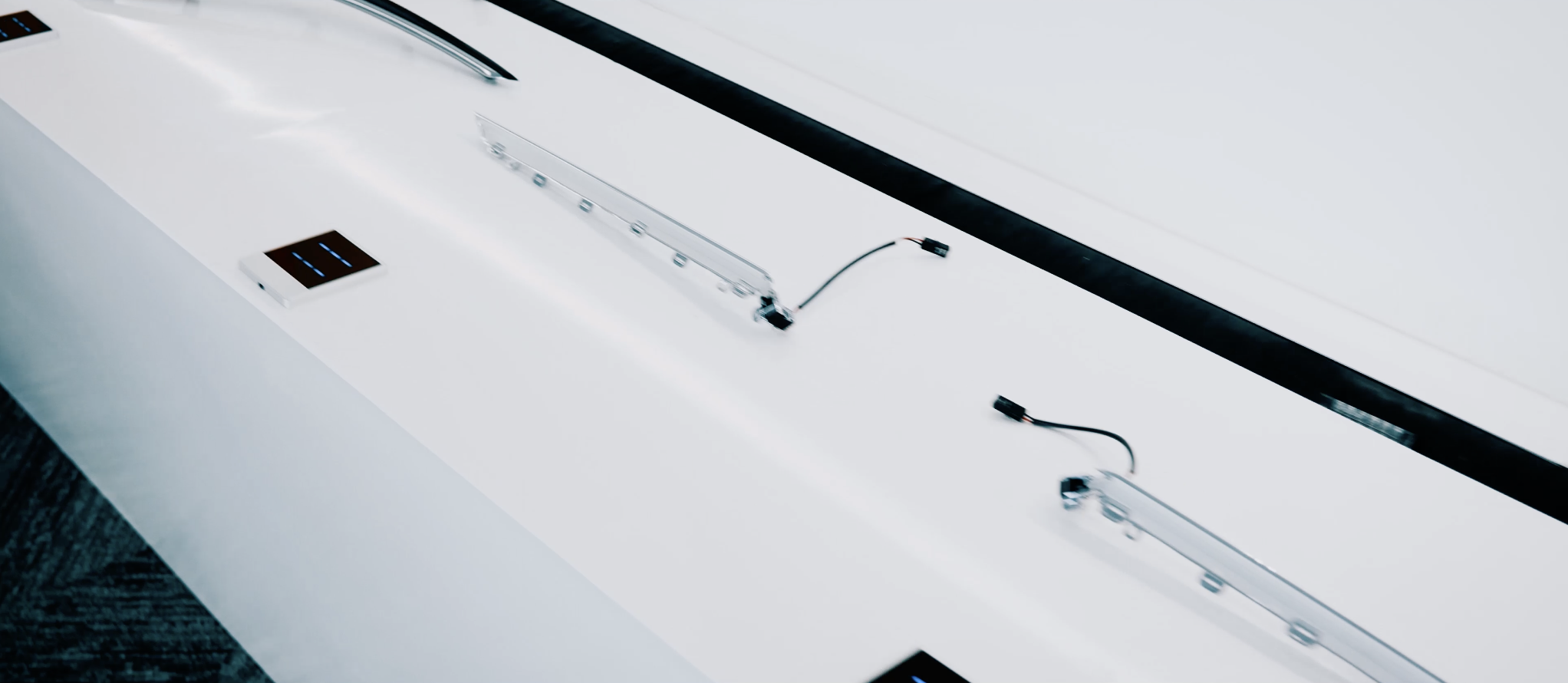
Light guides made from high-transmittance optical-grade material deliver even, soft illumination without obvious bright spots or dark areas, and can achieve bright output with low-power LEDs. Heat resistance, UV ageing resistance and vibration resistance are specified so that the part resists yellowing, embrittlement and light decay over long-term operation.
Street, outdoor and industrial lighting
LED street light secondary optics, industrial high-bay and low-bay optics and outdoor luminaires use freeform and asymmetric distributions so that light lands on the road or the work surface rather than above the horizontal. These are the applications where distribution control, rather than raw output, decides whether a luminaire meets its photometric target.
Security, stage and projection
Security flood lights, stage moving-head and wash lights, and LED projector optics all depend on controlled beam shapes — narrow for throw distance, wide and even for coverage. The matched hardware is consistent across these applications: high-power LEDs, COB LEDs, LED modules, heat sinks, drivers, reflectors and housings.
Linear, display and machine vision lighting
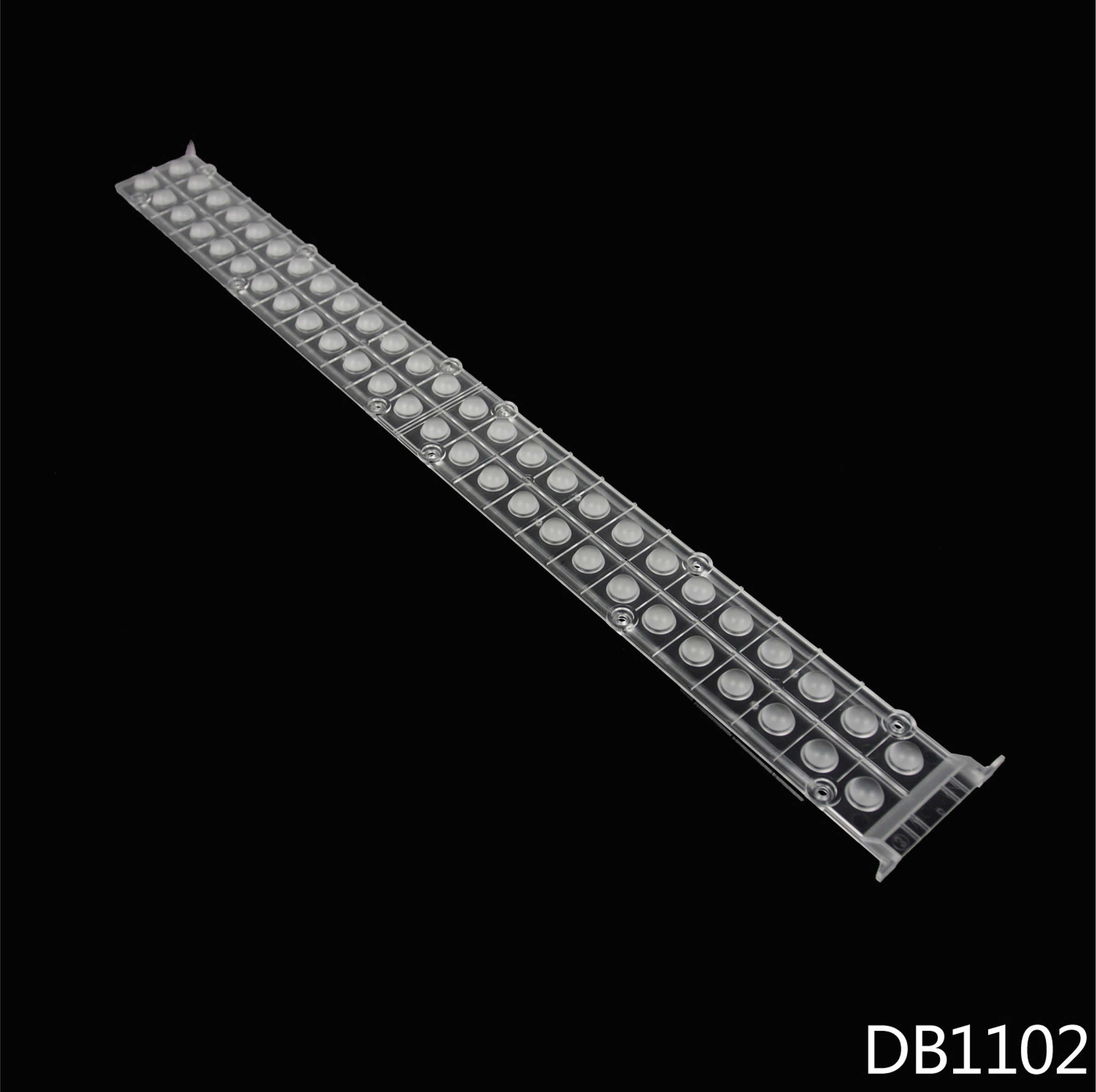
The DB1102 linear lens is built for linear LED luminaires, with an optical structure that reduces local bright spots and dark areas across an elongated zone. It is used in indoor linear lighting, display lighting, industrial lighting, architectural wall washing and machine vision lighting, where the requirement is continuous, uniform illumination of a strip.
Imaging and specialised optics
Machine vision lenses, security camera lenses, UAV optical lenses for imaging systems, and bicycle light lenses with tailored spot, flood or custom-shaped beams follow the same development route: optical requirement first, then tooling, then validated samples.
Comparison Table: Matching the Optical Element to the Task
The table below compares optical element types on the criteria that decide a specification: what the element does to the light, where it is typically used, and what constrains the design.
| Optical element | What it does to light | Typical applications | Design constraint |
|---|---|---|---|
| Aspheric LED lens | Shapes a rotationally symmetric beam, spot to flood | General LED lighting, downlights, spotlights | Beam-angle target within 2°–120° |
| TIR lens | Collects wide-angle emission and redirects it by total internal reflection | Narrow-beam and high-efficiency luminaires | Wall thickness and draft for demolding |
| Fresnel lens (DB1072) | Reproduces focal power through annular facets in a thin profile | Large-area lighting, solar concentration, sensors, size- and weight-sensitive devices | Thin, lightweight construction |
| Freeform lens | Produces asymmetric distributions and cutoff lines | Automotive headlamps, street and outdoor lighting | Optical surface definition and tooling precision |
| Linear lens (DB1102) | Spreads light evenly along a strip | Linear LED luminaires, display, industrial, wall washing, machine vision lighting | Length and width matched to the luminaire |
| Thick-wall lens (up to 50 mm) | Combines structural strength with dense micro-prism light extraction | Automotive headlamp and rear turn-signal optics | Thick-section molding, cycle time, shrinkage |
| Light guide (up to 1,300 mm) | Transports light along a length and releases it evenly | Automotive ambient lighting | Transmission, UV and heat resistance, long-part molding |
| Multi-cavity optical array | Gives each LED in a module its own distribution inside one part | Low-beam inner lens modules, multi-channel headlamps | Cavity-to-cavity consistency |
How to Shortlist China Custom Optical Lens Manufacturers
China is a significant source of custom optical lenses and precision optical molds, and the range of suppliers is wide: optical design houses, precision molders, plastic processors with a lens product line, and trading companies. The following criteria separate a development partner from a drawing-taker.
- Full-cycle development, not drawing-only production. Look for optical design, structural evaluation, DFM, mold flow analysis, mold design and fabrication, precision injection molding, optical testing and mass-production support under one roof. Review past custom projects and similar-product experience to confirm the supplier can co-develop rather than only manufacture to prints.
- In-house tooling and metrology. Mold cavity precision, CNC positioning accuracy, and inspection equipment such as blue-light 3D scanning and coordinate measuring machines for mold inserts decide whether the optical surface survives the transition from design to part.
- Optical validation, not only dimensional inspection. A supplier that measures only dimensions cannot confirm a beam pattern. Validation should cover dimensions, optical performance, appearance and assembly against the specification.
- Consistency across cavities and batches. Ask how raw material, molds, injection parameters, dimensional inspection, optical performance and appearance are controlled, and whether production is traceable.
- Capacity and continuity. For volume programmes, verify injection-molding equipment and actual production capacity, multi-cavity mold capability, mold service life, raw-material supply, quality management system, testing capacity, engineering and production teams, delivery lead time and abnormality response — and whether capacity can expand with order growth.
- Track record on complex geometry. Thick-wall parts, long light guides, TIR lenses, projection optics and multi-cavity molds require both optical understanding and injection-molding capability. Suppliers who know only one of the two tend to hand over risk at the sampling stage.
One structural advantage of using a single supplier from development through mass production is continuity: fewer technical hand-overs between a design house, a mold shop and a molder, and one specification revision in force throughout the project.
Frequently Asked Questions
What certifications and quality controls should a custom optical lens supplier hold?
At minimum, a supplier should hold ISO 9001 quality management system certification, and automotive lighting programmes should additionally require automotive-industry technical specification certification such as TS16949. Zhejiang Bicom Optics Co., Ltd holds ISO 9001 together with ISO 14001 and ISO 45001 (ISO 9001:2015, ISO 14001:2015, ISO 45001:2018) and has obtained TS16949 certification for the automotive industry. Certificates alone are not sufficient evidence, however. Ask how consistency is controlled across raw material, molds, injection-molding process, dimensional inspection, optical performance and appearance, and whether production is traceable by batch and by cavity.
Can a China-based manufacturer mold thick-wall lenses and long light guides?
Yes, where the supplier owns the tooling and the molding process. Bicom Optics produces high-precision thick-wall lenses up to 50 mm thick and high-precision automotive light guides up to 1,300 mm in length, with mold cavity precision adjustable to within 5 microns and nanoscale CNC positioning accuracy up to 10 nanometers. The company also molds two-colour and three-colour products in a single production run. The practical step for a buyer is to send the actual geometry and ask for confirmation against that specific part, rather than accepting a general capability statement.
What information is needed before a custom optical lens can be quoted?
A supplier needs 2D drawings, 3D data, optical data, material requirements, the product application and the service environment. The detail set should cover dimensions, tolerances, optical surfaces, assembly requirements, surface roughness, light-source information, material grade, working temperature and performance requirements. This package is what allows manufacturability, cost and development lead time to be assessed properly. Quotations for custom optics are built from the confirmed specification and manufacturing route, so the completeness of the input package directly affects how comparable quotes are between suppliers.
How does sampling and approval work for a custom optical component?
The standard workflow is requirement confirmation, engineering assessment, DFM, quotation, mold development, T0 sampling, test and validation, optimization, customer approval and then mass production. Either a prototype mold or a production mold can be used, depending on the project phase. Completed samples are validated for dimensions, optical performance, appearance and assembly in compliance with the product specification, and mold or process adjustments are made on the basis of those results. Mass production starts only after customer confirmation.
What determines development lead time and long-term supply security?
Development lead time is driven by the completeness of the input package, the findings of the DFM review, the mold development step and the number of validation iterations required — the sequence itself is fixed, but its duration depends on optical complexity. Supply security is a separate assessment: injection-molding equipment and actual production capacity, multi-cavity mold capability, mold service life, raw-material supply, quality management system, testing capacity, engineering and production teams, delivery lead time, abnormality response capability, and whether capacity can expand against order growth. If you already have a drawing package, the engineering team at Bicom Optics can review manufacturability and outline the sampling route — write to charlean@bicomoptics.com or visit www.bicomoptics.com.
Conclusion
A custom optical lens is not a component you buy from a list; it is a component you specify. The decision turns on five parameters — material, optical architecture, size envelope, beam angle and molding features — and it is validated through a development sequence that runs from requirement confirmation and DFM to T0 sampling, optical validation and controlled mass production.
For buyers at the research stage, the useful next step is not a price request but a manufacturability conversation: send the drawings, the optical data and the application conditions, and ask the supplier to confirm the part envelope, the validation plan and the consistency controls in writing. That exchange is what separates a supplier who can mold a lens from one who can deliver a beam pattern.
Request a sample or technical review
Zhejiang Bicom Optics Co., Ltd develops and molds custom optical lenses, precision injection molds and custom optical components — LED optical lenses, automotive lighting lenses, industrial lighting optics, machine vision lenses, security camera lenses and UAV optical lenses. Share your 2D/3D data and optical requirements for a manufacturability review and a sample plan.
Email: charlean@bicomoptics.com · Tel: +86 135-5877-5757 · www.bicomoptics.com
Address: No.258, West Yunsi Rd, Dayun Town, Jiashan County, Jiaxing City, Zhejiang Province, China
Have Questions or Need More Details?
Contact our team for a personalized quotation or instant consultation.
Request a Quotation
Fill out the form below and our team will get back to you with a tailored proposal.
WhatsApp Direct Chat
Prefer to chat in real-time? Message us on WhatsApp for instant assistance & quick answers.
- Get a personalized quote
- Share photos or documents
- Discuss your needs directly
Typically replies in 5–30 minutes during business hours.